A living wage is a level of pay that gives workers and their families a decent standard of living. This includes being able to afford basic needs such as food, housing, healthcare, education, transport and clothing.
Living wages are generally higher than minimum wages. Living wages are also voluntary – employers can choose whether to offer them – whereas minimum wages are required by law. (ILO)

GRI Living Wage 2024
Living
Wage
(+17.2% compared to base year)
57.2% of our key production partners’ employees earn at least a living wage, instead of a legal minimum wage
Our goal to achieve living wage by 2030, touches upon 2 out of 8 Sustainable Packaging Criteria

By 2030, 100% of our key production partners’ employees earn at least a living wage.
Goal
A first basic risk assessment performed in 2022 showed that at least six key production partners are based in countries and/or industries where the minimum wage does not equal a living wage, and ‘wages’ and ‘working hours’ are salient issues according to the Sedex Inherent Risk Score. These risk production partners are not SA8000 certified and employ 60% of total potentially impacted employees. Meaning, in 2022, 40% of our key production partners’ employees most likely earned at least a living wage.
Baseline
Royal LC Packaging aims to enable all our Tier 1 key production partners to pay their employees at least a living wage by 2030. In 2024, these production partners together represented 81% of our total procurement spend and employed 20,309 employees and contractors.
Scope
In 2024, 57.2% of key production partners’ employees earn a least a living wage, compared to an estimated 40% in 2022.
Progress on goal
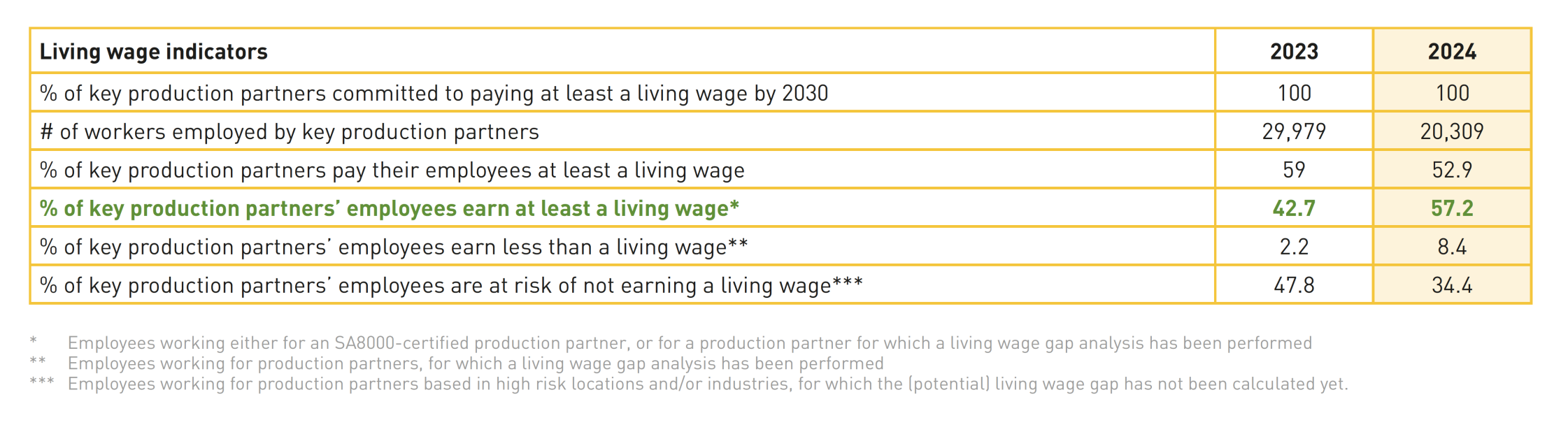

*Employees working either for an SA8000-certified production partner, or for a production partner for which a living wage gap analysis has been performed
**Employees working for production partners, for which a living wage gap analysis has been performed
*** Employees working for production partners based in high-risk locations and/or industries
57.2% earned at least a living wage*
8.4% earned less than a living wage**
34.4% are at risk of not earning a living wage***
100% of LC Packaging’s key production partners committed to paying at least a living wage by 2030. Based on the data available during the publication of this report, we can state that of the 20,309 employees employed by our key production partners in 2024:
In 2024, 7 Living Wage Gap Analyses were performed. Additionally, LC Packaging conducted a Global Labour Risk Assessment for its key production partners, including a risk level on living wages paid, based on whether statutory minimum wages are sufficient to cover basic living costs.
52.9% of our key production partners are considered living wage partners. They either proved they pay a 100% living wage through a gap analysis, or an SA8000 certification, or they operate in countries where a minimum wage equals or exceeds a living wage and provided proof of paying at least that minimum wage.
All key production partners in risk areas have now joined LC Packaging’s Living Wage Programme.
Explanation
Actions
In 2024, we continued educating our key production partners on the topic of living wages and ensured commitment towards achieving living wages by no later than 2030. Furthermore, as part of our living wage programme, with help of IDH – Sustainable Trade Initiative, we supported our partners in calculating living wage gaps, which has led to constructive dialogues towards closing the living wage gap.
01
01
Policies, codes, and commitments
02
Awareness and
implementation
03
Research and
development
04
Data and
reporting
Policies, codes, and commitments
We have participated in the United Nations Global Compact Forward Faster Programme as we have committed to establishing joint action plans with contractors, supply chain partners and other stakeholders to work towards achieving living wages with measurable and time-bound milestones.
For our additional production partners, the Code of Conduct for Production Partners has been updated and distributed. Included is a commitment to pay at least a living wage by 2030.
Our updated Human Rights Policy and Sustainable Supply Chain Policy were communicated and implemented.
All our key production partners have signed the dedicated Code of Conduct for Key Production Partners. This code includes a binding commitment to pay at least a living wage by 2030.
Next steps
As looking forward is even more important than looking back, below is a brief overview of actions we are planning to take next.


Continue the dialogue with key production partners and – as part of our living wage programme – support them in calculating the living wage gap and achieving and maintaining living wages.

Include other (less strategic) production partners in the living wage programme and ensure an action plan towards 2030.

Further improve data quality and availability, leading to more reliable data for living wage reporting, steering and decision making.

Join programmes and initiatives, such as the UN Global Compact Forward Faster Programme and networks of peers in living wage ambition, to share best practices and promote the necessity of living wages.

For more detailed information on social topics related to our workforce and workers in our value chain, please refer to our 2024 Sustainability Report.
2024 Sustainability Report
2024 Sustainability Report
GRI Living Wage 2024

Living
Wage
Our goal to achieve living wage by 2030, touches upon 2 out of 8 Sustainable Packaging Criteria
A first basic risk assessment performed in 2022 showed that at least six key production partners are based in countries and/or industries where the minimum wage does not equal a living wage, and ‘wages’ and ‘working hours’ are salient issues according to the Sedex Inherent Risk Score. These risk production partners are not SA8000 certified and employ 60% of total potentially impacted employees. Meaning, in 2022, 40% of our key production partners’ employees most likely earned at least a living wage.
Baseline
57.2% of our key production partners’ employees earn at least a living wage, instead of a legal minimum wage
(+17.2% compared to base year)
A living wage is a level of pay that gives workers and their families a decent standard of living. This includes being able to afford basic needs such as food, housing, healthcare, education, transport and clothing.
Living wages are generally higher than minimum wages. Living wages are also voluntary – employers can choose whether to offer them – whereas minimum wages are required by law. (ILO)
By 2030, 100% of our key production partners’ employees earn at least a living wage.
Goal
Royal LC Packaging aims to enable all our Tier 1 key production partners to pay their employees at least a living wage by 2030. In 2024, these production partners together represented 81% of our total procurement spend and employed 20,309 employees and contractors.
Scope
In 2024, 57.2% of key production partners’ employees earn a least a living wage, compared to an estimated 40% in 2022.
Progress on goal
Explanation
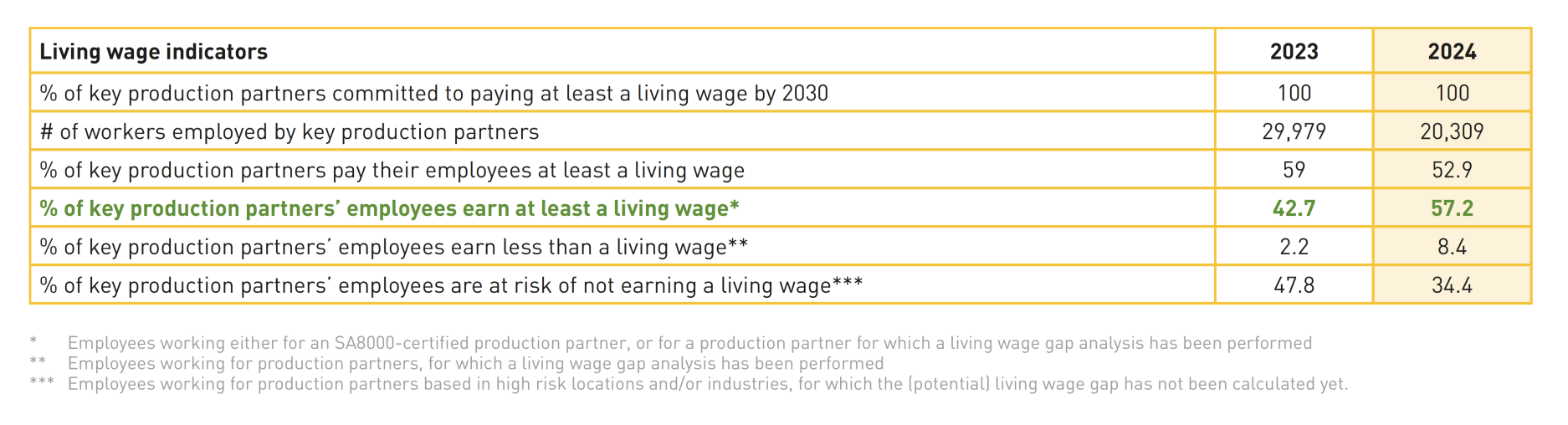
100% of LC Packaging’s key production partners committed to paying at least a living wage by 2030. Based on the data available during the publication of this report, we can state that of the 20,309 employees employed by our key production partners in 2024:
57.2% earned at least a living wage*
8.4% earned less than a living wage**
34.4% are at risk of not earning a living wage***
In 2024, 7 Living Wage Gap Analyses were performed. Additionally, LC Packaging conducted a Global Labour Risk Assessment for its key production
partners, including a risk level on living wages paid, based on whether statutory minimum wages are sufficient to cover basic living costs.
52.9% of our key production partners are considered living wage partners. They either proved they pay a 100% living wage through a gap analysis, or an SA8000 certification, or they operate in countries where a minimum wage equals or exceeds a living wage and provided proof of paying at least that minimum wage.
All key production partners in risk areas have now joined LC Packaging’s Living Wage Programme.
*Employees working either for an SA8000-certified production partner, or for a production partner for which a living wage gap analysis has been performed
**Employees working for production partners, for which a living wage gap analysis has been performed
*** Employees working for production partners based in high-risk locations and/or industries
Actions
In 2024, we continued educating our key production partners on the topic of living wages and ensured commitment towards achieving living wages by no later than 2030. Furthermore, as part of our living wage programme, with help of IDH – Sustainable Trade Initiative, we supported our partners in calculating living wage gaps, which has led to constructive dialogues towards closing the living wage gap.
01
02
03
04
Policies, codes,
and commitments
Our updated Human Rights Policy and Sustainable Supply Chain Policy were communicated and implemented.
For our additional production partners, the Code of Conduct for Production Partners has been updated and distributed. Included is a commitment to pay at least a living wage by 2030.
We have participated in the United Nations Global Compact Forward Faster Programme as we have committed to establishing joint action plans with contractors, supply chain partners and other stakeholders to work towards achieving living wages with measurable and time-bound milestones.
All our key production partners have signed the dedicated Code of Conduct for Key Production Partners. This code includes a binding commitment to pay at least a living wage by 2030.
Awareness
and implementation
Our Living Wage Programme for our key production partners was introduced in August 2023 and further implemented in 2024. The programme, supported by IDH – Sustainable Trade Initiative, consists of five steps designed to help partners to achieve and maintain a living wage by at least 2030.
A mandatory online training course on our living wage commitment is available for all employees. On 31 December 2024, the course had a completion rate of 79.5%.
Following the workshops organised for employees in 2022, all new hires participate in a dedicated workshop on Royal LC Packaging’s 2030 Ambition, including our living wage commitment.
Customers have been educated on the topic of living wages using a living wage case, comparing the price of an average product produced by employees receiving a minimum wage to that same product if it were produced by employees receiving a living wage.
Goals and KPIs have been implemented throughout relevant parts of the organisation to ensure living wages are paid and our stakeholders are educated on the topic.
Research
and development
In 2024, a global labour risk assessment was performed to identify production partners who are at risk of not paying a living wage.
Research outcomes of in-depth research that was conducted in collaboration with Sedex in 2023, have been used to advise on relevant living wage benchmarks, initiatives, regulatory developments, and implementation challenges and solutions in areas where key production partners are based.
Data
and reporting
The IDH Salary Matrix is used to calculate the living wage gap for our key production partners. This tool enables us to more accurately report on progress. In 2024, seven living wage gap analyses were performed.
Our in-house Salary Matrix key user supports and advises production partners with filling out the tool and checking the results.
Our due diligence process was updated and implemented to collect additional data to be able to conduct a more in-depth risk assessment in our value chain.
Next steps
As looking forward is even more important than looking back, below is a brief overview of actions we are planning to take next.

Continue the dialogue with key production partners and – as part of our living wage programme – support them in calculating the living wage gap and achieving and maintaining living wages.

Include other (less strategic) production partners in the living wage programme and ensure an action plan towards 2030.

Further improve data quality and availability, leading to more reliable data for living wage reporting, steering and decision making.

Join programmes and initiatives, such as the UN Global Compact Forward Faster Programme and networks of peers in living wage ambition, to share best practices and promote the necessity of living wages.
For more detailed information on social topics related to our workforce and our value chain, including health and safety, talent and development, human rights, business ethics, and information security, please refer to our 2023 Social Report.
2024 Sustainability Report
2024 Sustainability Report